
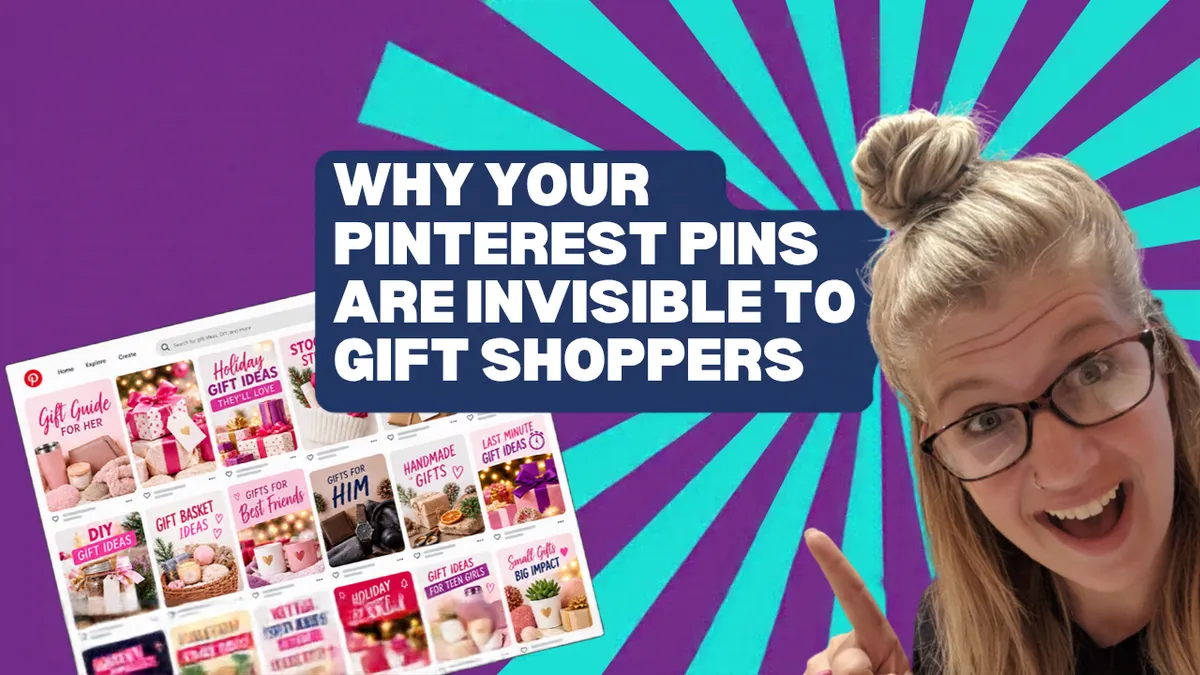
You Typed In the Wrong Address and Then Drove It Beautifully
You Typed In the Wrong Address and Then Drove It Beautifully
Go look at your best seller from last December. The product, not the pin. Now tell me who paid for it.
If the answer is somebody buying it for somebody else, every pin you wrote for that product last year was written for the wrong person. And Pinterest just published the receipts.
You Typed In the Wrong Address and Then Drove It Beautifully
You Typed In the Wrong Address and Then Drove It Beautifully
What Her Fourth Quarter Showed
"Laura, I Know My Audience"
I hear this on almost every call I take in October, and the women saying it are good at it. She's 34, she's got a Shopify store and two kids. Every word of it is about her customer, and her customer and her searcher are the same person 10 months out of 12.
I've told you before about the day I missed my turn. What actually happened is I missed the entire freeway. The car was fine. My driving was fine. I had typed in the wrong address, and everything after that was efficient travel toward a place I had no interest in going.
That's this. Your pins are fine, your photography is great, your keywords are in the right places. You typed in the wrong address and then you drove it beautifully.
Why Your Pinterest Pins Are Invisible to Gift Shoppers: Spotify
Why Your Pinterest Pins Are Invisible to Gift Shoppers: Apple
Two Numbers From Pinterest
Pinterest put out their 2026 men's trends report in September. Two numbers in it are worth your afternoon. Gen Z men now account for more than 62% of all male monthly searches on Pinterest, up about 17% year over year. Charcuterie board design is up around 390%.
Sit with that second one. If you sell serving boards or cheese knives, or you blog about hosting, a real chunk of the people typing that phrase right now are men. A lot of them are shopping for somebody who hosts. Same phrase, different human, different sentence.
Men are one example of a bigger pattern: gifting season breaks the link between the searcher and the user. In November, the woman who wanted the linen apron is the one who gets it, and her sister is doing the typing.
And this is a year-round thing. Mother's Day, host gifts, birthday gifts, girlfriend gifts. Gifting search in most categories starts climbing in June.
What Her Fourth Quarter Showed
A shop owner I worked with sells nice things for the bath. Beautiful photography, steady traffic, and every description read like the label. Ingredients, scent notes, how it feels on your skin.
We sorted her previous fourth quarter by outbound clicks, the number that tells you somebody actually left Pinterest. Her top three earners in the first two weeks of December were all bundles, because a bundle solves the problem of not knowing what to buy. And roughly nobody buying that bundle was going to use the soap.
She hadn't done anything wrong. She'd just never been given a reason to check.
Three Free Places to Find Your Buyer
Your own analytics. Audience insights, demographics tab, filtered to your top pins from last October through December. It moves hardest in the two months ahead.
Your search bar. Type your main product and stop. Those completions under your cursor record how real people finished that phrase. If "for him" or "for dad" shows up and it's nowhere in your descriptions, you just found your gap in nine seconds.
Your saves against your outbound clicks. Lots of saves and few clicks is usually the end user, saving to a board called Someday. Fewer saves and more clicks is usually a buyer, checking the price and the shipping date.
Read It as the Person Paying
Three places the mismatch lives: the title, the first line of the description, and the board it sits on.
"Handmade walnut serving board, food safe finish" names the owner. "Housewarming gift for the friend who hosts everything" names the buyer. Same page, same photograph, two completely different people typing.
The first line matters most, because it's what a human sees before they tap to expand. Almost everybody front-loads the brand, and the reader is gone before they reach who it's for. The buyer version does two jobs in 12 words. It names the occasion and the recipient. "For the friend who hosts every holiday and never lets you help." The finish and the dimensions still go in, second and third.
Build the Second Door
Leave the pin that's working alone. It has history, searches attached, and position it earned over months. Edit that title and you can lose it.
Build a second pin instead. Same page, a different image, a new title for the person paying, and a description that names the occasion.
Two doors, one room. She finds it by searching for what the thing is. He finds it by searching for who it's for, and the computer is happy to rank both.
Final Pin Drop
Pull your top five earners from last fourth quarter, sorted by outbound clicks. Read those titles out loud and ask who each one was written for, the person who unwraps it or the one who pays.
If two of five were written for the wrong one, you just found your October project.
📌 Book a PinChat → laurarike.com/pinchat


