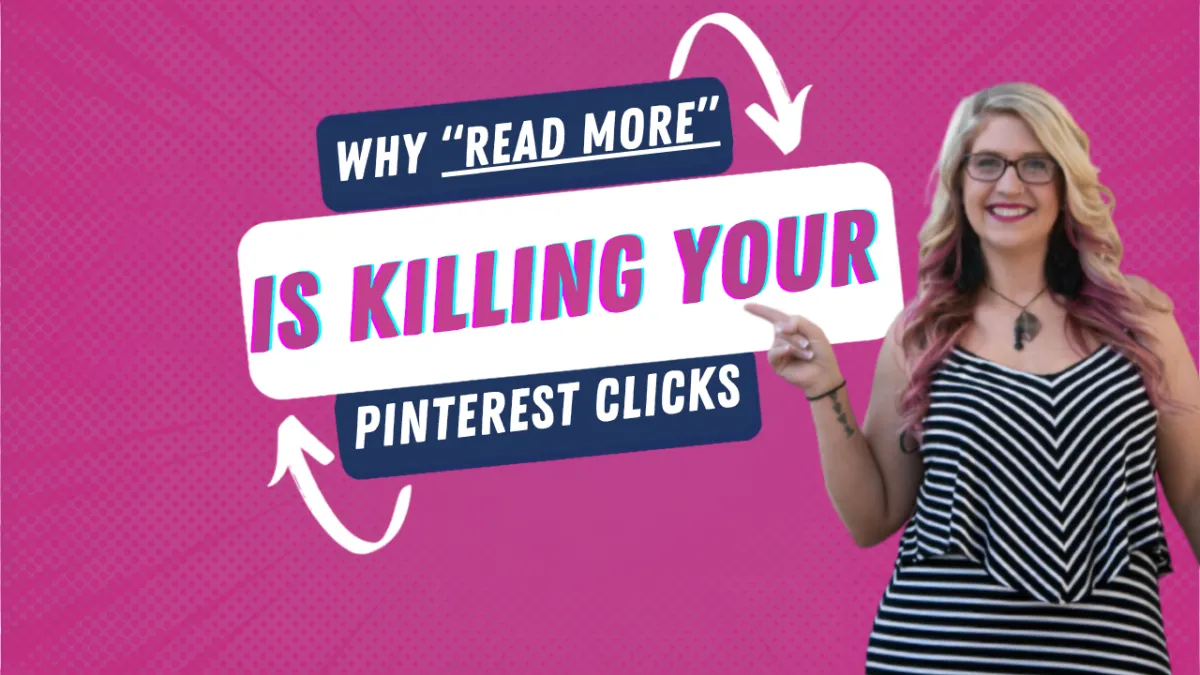
Why "Read More" Is Killing Your Pinterest Clicks
Why "Read More" Is Killing Your Pinterest Clicks
If your pins say "Read More" and nobody's clicking through, look at those two little words before you blame the algorithm one more time.
Here's what I'm seeing lately. Someone comes to me pinning consistently. Good designs, keywords in place, getting saves and impressions, maybe a couple clicks. But it's not what they want, and they're convinced Pinterest is broken. Almost every time, it's the call to action. It isn't asking for anything specific, so it doesn't get anything.
Why "Read More" Is Killing Your Pinterest Clicks
Why "Read More" Is Killing Your Pinterest Clicks
Vague Isn't Polite, It's a Dead End
Name the Outcome, Not the Format
Say It Twice, and Keep the Promise
The Laundry Story
One morning I noticed the laundry wasn't folded, the thing my husband said he'd get to. We'd discussed it. But I never told him I wanted it done right now, because I had plans for us later. He had his own timing in mind. I assumed. I didn't say what I needed, or why.
Same thing with your call to action. If you're not telling people exactly what to do and why, they'll assume something different.
Why "Read More" Is Killing Your Pinterest Clicks: Spotify
Why "Read More" Is Killing Your Pinterest Clicks: Apple
Vague Isn't Polite, It's a Dead End
When I do an audit, what people have often written is a suggestion. Read more. Click here. Learn more. These are polite, vague, and ask the person to make the whole decision themselves. Read more of what?
A good call to action is an instruction. It tells the person the one thing to do, what they get, and why it helps them. On Pinterest, where someone is actively searching, a clear instruction is a gift, not a pushy one.
Nine out of ten people on Pinterest show up ready to shop, plan, learn, or hire. So when a pin says "Read More," you hand that ready person a blank screen. Is it worth leaving the scroll? Usually the answer is "meh, maybe," so they keep scrolling. Give them the decision already made instead.
Name the Outcome, Not the Format
This is the actual swap. Stop describing the format. Describe what they walk away with.
Read More becomes "Get the free packing checklist." Click here becomes "Grab this template I use for every launch." The second version tells them exactly what they get and why they want it. I'm not adding pressure, just being specific. And specific wins over pushy every time, because specific is what people are searching for.
A shop owner recently couldn't figure out why her pins were saved but never clicked. Every pin said "Shop now." So I asked, "Shop what?" We changed it to name the actual item: shop the linen weekender bag, shop the vanilla candle. Same photos, and the clicks showed up, because now people knew what they were tapping to receive.
Say It Twice, and Keep the Promise
Your call to action needs to live in two spots: on the pin image and in the description. People act on the image first, judging it in a second. If your outcome is right there on the graphic, they know what tapping gets them before reading another word. And make it legible: if grandma can't read it at arm's length, it's too small.
Here's the piece that quietly fixes a lot of "Pinterest doesn't convert for me" problems. Match your words to what's on the other side. If your pin says "Get the free checklist," the checklist better be the first thing they see when they land. Not a homepage. The checklist, right there.
When the page keeps the promise, the click turns into a subscriber or a sale. When it shows something different, they bounce, and Pinterest notes that your pin didn't deliver, then turns down the volume on the whole thing. One pin, one promise, one place to land.
Sometimes the Smartest Ask Is a Save
Not every pin should shout "come buy, come click, come download." Some people aren't ready yet. They're bookmarking for the trip in a few months, the spring project, the Q4 budget. So sometimes the perfect call to action is, "Save this for when you're ready."
Here's the sneaky good part. A save is one of the strongest signals you can send Pinterest. It says "this was worth keeping," and Pinterest shows your pin to more people like that pinner, building the audience that buys later.
Final Pin Drop
Your call to action is a handful of words asking someone who's already leaning in to take one clear step. When those words name a real outcome, live on the image and in the description, and match what's on the other side, your pins start moving. Same designs, same keywords, just clearer.
If you do one thing after this, pull up your five most pinned pins. If any say "Read More" or "Click here," rewrite that line to name exactly what the person gets, then save it as a new pin and test it. Don't touch the old ones. Pinterest is dynamic, and deleting only wastes your time. Five pins, five clearer promises. That's the whole assignment.
📌 Book a PinChat → laurarike.com/pinchat


